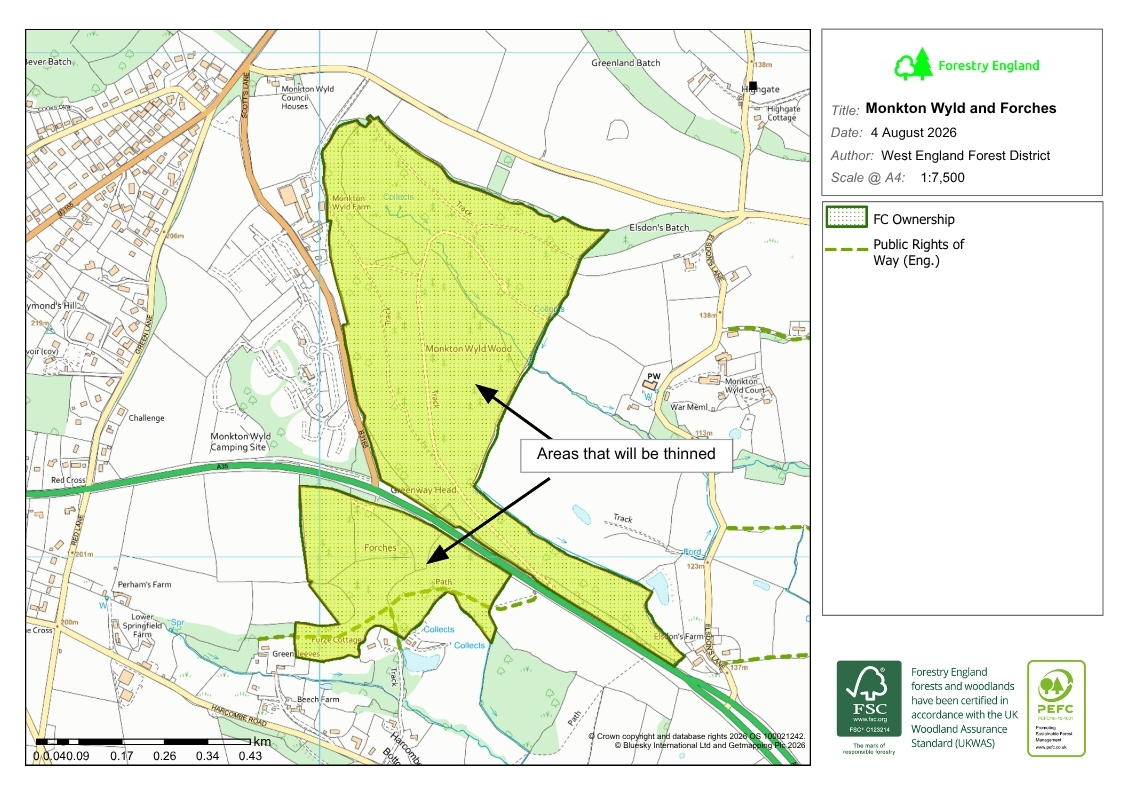
Harvesting work will be commencing this week for approximately 6-8 weeks, at Monkton Wyld in West Dorset & Forches Woodlands in East Devon, where Forestry England will be thinning trees. Work will commence during weekdays 8am to 5pm with the sites being closed throughout the weekend.
They will be thinning across a large area of the woodlands. This means removing selective trees for timber products. This gives the remaining trees more light and space to grow to their full potential. It also lets more light onto the forest floor which helps the flora. This is part of their long-term sustainable management of Monkton Wyld and Forches. There is more information about this work on their website at The lifecycle of a forest | Forestry England
They will also be thinning some trees within Monkton Wyld that is in a PAWS (plantation on ancient woodland site). This will help to give the broadleaves there more regeneration, as they restore the site back to woodland comprising site native species.
The woodland of Monkton Wyld will be completely closed (the woodland north of the A35) to public access. The woodland of Forches will also be completely closed (the woodland south of the A35) as well as the public rights of way to public access. Please follow all signs and instructions at all times.
Forestry work is very hazardous. A falling tree can weigh several tonnes and hit the ground at nearly 60mph. If a harvesting machine chainsaw snaps, it can fly through the forest like a bullet.
Thorough ecological surveys have taken place to check for species such as birds, mammals, rodents, invertebrates, flora, and fungi. Forestry England will consider these findings against complex factors including tree health, how the ground slopes, soil condition, and likely rainfall when planning work that will support their long-term management plan. Our working windows are dictated by site ground conditions too, so most of East Devon work is preferred in the summer to minimise soil damage. There isn’t a single, perfect time of year for forestry work.
Thinning woodland will improve habitat for nesting birds but also wider ecological improvements in terms of biodiversity. They will retain any trees with nests. Presence of schedule one species will be checked prior to commencement and operations stopped if necessary. There is more information about this work on their website at Felling and nesting birds | Forestry England
There is a map to explain where works will be. In areas highlighted yellow they will be conducting routine thinning to maintain the health and quality of the trees in the woodlands.
You can read the full forest plan for Monkton Wyld and Forches online at East Devon Forest Plan | Forestry England
If you have any questions or queries, please refer them to westengland@forestryengland.uk.
Community noticeboard News
Share